The Atlanta Journal-Constitution reported yesterday that customers are increasingly buying private label store brands due to the poor economy (click here). The article quotes research from Nielsen that shows that private label sales grew 10% YTD whereas name brands grew by 3.5% only over the same period.
Earlier research from Nielsen (click here) shows that consumers increasingly think that store brands are a good alternative to name brands and have a comparable quality. Fewer people (24%) think that name brands are worth the extra price. More people now feel that store brands are not only for consumers on a tight budget.
Category managers must ask themselves: Should I discount my name brand to compete against the store private label?
The answer may be different for different product categories and even for different store formats.
The share of private label products varies across categories (click here). It is high for pet food, frozen/refrigerated food and plastic/paper products. It is very low for beverages, home care, baby food, cosmetics, snacks/ confectionery, and hygiene products.
Surprisingly price differentials between private labels and name brands are lowest in categories where the share of private labels is high (around 20%). Price differentials in some categories where store brands have low share are as high as 40%.
This suggests that the price sensitivity and the importance of brand is different in each category. Name brands should use pricing analytics to understand the share and volume impact of various pricing differentials in the specific category.
For some categories (e.g. bottled water), it may make sense for the name brand to focus on low unit-count packs rather than focusing on the bulk-use packs. Consumers who buy bulk-use packs are more likely to be price sensitive.
It is also important to understand that private label receptiveness is much lower in convenience stores than in grocery chains (click here). It is important for category managers to analyze price sensitivity (by share and volume)for their brand for each retail chain separately. Discounting products in a convenience store chain may yield little/ no benefit whereas it may be a good decision at a wholesale chain.
Showing posts with label recession. Show all posts
Showing posts with label recession. Show all posts
Thursday, December 11, 2008


Wednesday, December 10, 2008
Should Abercrombie discount its wares?
The Wall Street Journal reported earlier this week that Abercrombie & Fitch is pursuing a strategy of not discounting its apparel (fashion brands targeted at young people) during the current recession (click here). The article mentions that their competitors (American Eagle Outfitters, Aeropostale, QuikSilver, Pacific Sunwear) have discounted their apparel significantly.
While competition has seen same-store sales decline by 10-11%, Abercrombie's November same-store sales fell by 28%. However Abercrombie enjoys the highest gross margins (66%) compared to competitors who have much lower margins (AEO:41%; Gap:38%; J Crew:43%, Pacific sunwear:29%). The management insists that discounting will lead to long-term erosion of brand value.
I can't help but ask myself: Should Abercrombie discount its wares?
I think there is a strong case for Abercrombie to consider pricing lower selectively. Here's why:
While competition has seen same-store sales decline by 10-11%, Abercrombie's November same-store sales fell by 28%. However Abercrombie enjoys the highest gross margins (66%) compared to competitors who have much lower margins (AEO:41%; Gap:38%; J Crew:43%, Pacific sunwear:29%). The management insists that discounting will lead to long-term erosion of brand value.
I can't help but ask myself: Should Abercrombie discount its wares?
I think there is a strong case for Abercrombie to consider pricing lower selectively. Here's why:
- Abercrombie's target population has been hit hard by the recession due to potentially reduced pocket money from parents (for younger teens) to bleaker job prospects (for recent graduates) to higher tuitions and costlier student loans (for college students). Clearly, the target customers will cut back on apparel spending, especially on premium brands.
- Abercrombie has a 66% gross margin (Yep, you read that right: their average cost of goods sold is only a third of the average price). However its fixed costs (marketing and distribution expenses) run to more than $450 MM per quarter (~54% of sales in the Nov'08 quarter). This is much higher than the comparables for most competitors.
- Assuming that marketing and distribution costs remain largely fixed, Abercrombie will make a loss if its sales decline a further 15% from Nov'08 quarter levels.
- Based on current sales and inventory numbers, Abercrombie is carrying more than 50 days of inventory. This is a fairly high level in Abercrombie's history. Inventory pile-up could force it to discount later(as winter-wear will need to be sold off before spring).
- Although there is a strong case for brand equity dilution, Abercrombie could consider structuring the discount selectively on products that are slow-moving. Also it can be relatively discreet about its discounts so that it does not impact brand image.
Advertising in a recession economy
Most ad agencies and marketers are expecting a significant reduction(4-6%) in US ad spending in 2009 after being flat/ slightly down in 2008 (click here for Dec 8 Bloomberg article). McClatchy, a leading US newspaper company, reported a 17% decline in ad revenues for the first 10 months of 2008 (click here). Most experts are anticipating at least 5% growth in internet spending and more than 5% decline in magazine and TV ads.
I personally think the 2009 number could be closer to the lower end of expectations. Let me explain. Advertising Age has tracked US ad spend for the top 100 marketers in a report called Marketer Trees 2008. The split of the $105 BN spent by the top 100 marketers shows that financial services and automotive were key spenders (22% of total). These industries have been badly hit by the recession and can reasonably be expected to cut advertising spend significantly.
 Other key sectors such as Drugs, Retail,Personal care, and Telecom (specifically mobile) are also experiencing slow down and are likely to slow their spending. One of the biggest spenders, P&G, has reduced its ad spending by 6% YTD till September 2008. As such I think ad spending is likely to reduce significantly
Another interesting angle is that of ad spends as a percentage of sales. Many top consumer brands currently spend more than 10% of US sales on US advertising. These companies will surely see the need to cut advertising spends and use the savings to reduce pricing during the recession.
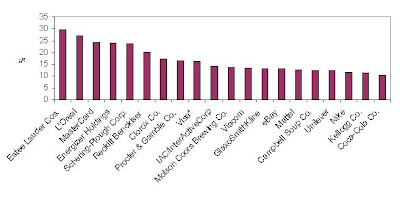
Brand marketers are facing a vexing problem: How should we change advertising spends and media mix in the recession economy, without reducing communication to the consumer? Can we rely on historical RoI data and historical Media Mix models in a rapidly changing marketplace?
Here are my thoughts:
I personally think the 2009 number could be closer to the lower end of expectations. Let me explain. Advertising Age has tracked US ad spend for the top 100 marketers in a report called Marketer Trees 2008. The split of the $105 BN spent by the top 100 marketers shows that financial services and automotive were key spenders (22% of total). These industries have been badly hit by the recession and can reasonably be expected to cut advertising spend significantly.
 Other key sectors such as Drugs, Retail,Personal care, and Telecom (specifically mobile) are also experiencing slow down and are likely to slow their spending. One of the biggest spenders, P&G, has reduced its ad spending by 6% YTD till September 2008. As such I think ad spending is likely to reduce significantly
Another interesting angle is that of ad spends as a percentage of sales. Many top consumer brands currently spend more than 10% of US sales on US advertising. These companies will surely see the need to cut advertising spends and use the savings to reduce pricing during the recession.

Brand marketers are facing a vexing problem: How should we change advertising spends and media mix in the recession economy, without reducing communication to the consumer? Can we rely on historical RoI data and historical Media Mix models in a rapidly changing marketplace?
Here are my thoughts:
- Many marketers will be able to reduce media spending significantly without reducing brand exposure and communication due to falling ad rates (for TV ads, newspapers, magazines). Online advertising rates are also falling (click here for article).
- Marketers need to seriously assess the need to reduce brand exposure (Rating points, online clicks, etc) based on continuous monitoring of the competition. Any sudden changes in 'share of voice' could have adverse impact on market share.
- Although internet advertising had immediate and measurable impact on brand communication (and sales), marketers should not underestimate the long-term impact of traditional media (TV, magazines). Any dramatic reductions in brand exposure through traditional media could have adverse long term impact.
- Analytical models (media mix models, media RoI models) based on historical data need to be relooked based on the changing circumstances. RoI measures need to broken down into 'sales impact per rating point' and 'price per rating point'. The new media pricing for 2009 can be factored into the analysis to re-adjust RoI estimates for 2009.
Wednesday, December 3, 2008
Layaway: Sound recession strategy or outdated retail gimmick?
The Washington Post reported this weekend that layaway programs are back at retailers like KMart and Sears (click here for article) . Click here to get the KMart layaway program details.
In a layaway, shoppers put a small down payment on merchandise and pay a service charge of roughly $5 to $10. Shoppers must return every few weeks for 2-3 months to make payments until the merchandise is paid off. Only then can they take their prized possession home.
Such programs were popular during the Great recession but have been discontinued by most retailers in the past few decades.
I can't help but ask: Is the layaway program a sound recession marketing strategy or is it an outdated retail gimmick?
Here's what's working for layaway this season:
Store chains should be careful not to use layaway as a technique to make easy money from cash-strapped customers (e.g., They should offer extensions to customers who are late on their last payment). They will likely lose customers who lose their holiday presents to a missed payment.
In a layaway, shoppers put a small down payment on merchandise and pay a service charge of roughly $5 to $10. Shoppers must return every few weeks for 2-3 months to make payments until the merchandise is paid off. Only then can they take their prized possession home.
Such programs were popular during the Great recession but have been discontinued by most retailers in the past few decades.
I can't help but ask: Is the layaway program a sound recession marketing strategy or is it an outdated retail gimmick?
Here's what's working for layaway this season:
- As is pointed out in the article, the fees for the layaway program are much lower than credit card late payment fees.
- It forces people to budget for items they truly want to buy. Even Oprah Winfrey mentioned it on her TV show.
- It requires people to have the financial and mental discipline to buy what they can afford and wait for a few months to get it. This would be especially difficult for people who have not maxed out their credit limits.
- Customers who lose merchandise because they could not make a payment in time will be disillusioned and may not use it next year.
- Customers who make layaway payments using credit cards could be pushed further into debt.
Store chains should be careful not to use layaway as a technique to make easy money from cash-strapped customers (e.g., They should offer extensions to customers who are late on their last payment). They will likely lose customers who lose their holiday presents to a missed payment.
Subscribe to:
Posts (Atom)